

Table of Contents
- Why 3D Printed Shelf Decor Belongs in Every Gaming Room
- 3D Printed Controller Stands: Functional Desk Organization
- Best Filaments for Gaming Room Decor That Lasts
- Modular Storage and Console Organization Ideas
- LED Integration and Wall-Mounted Display Shelves
- Board Game Storage and Geek Decor That Doubles as Art
- Installation, Safety, and Post-Processing for a Retail Finish
- Conclusion: Building a Shelf That Reflects Your Setup
- Frequently Asked Questions
Last Updated: October 4, 2026
Why 3D Printed Shelf Decor Belongs in Every Gaming Room
3D printed shelf decor for gamers fits the exact space, theme, and gear you already own. This guide covers the pieces worth printing, the filaments that survive a hot room, and the mounting mistakes that send shelves crashing onto a desk.
Store-bought shelving gives you three widths and two colors; a printed shelf bracket gives you whatever you design.
The practical argument is cost: a spool of PLA runs a fraction of a single branded shelf and prints several brackets. The design argument is stronger still, nothing on a retail shelf says "this room belongs to someone who plays."
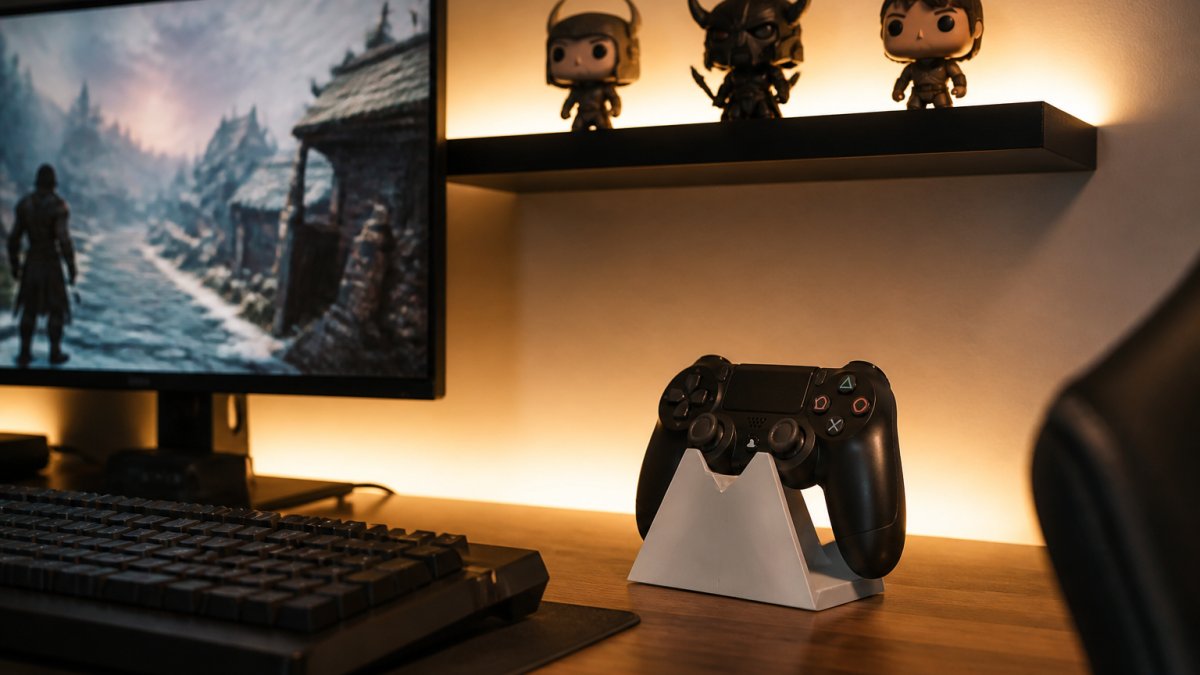
3D Printed Controller Stands: Functional Desk Organization
3D printed controller stands are the highest-value print in this category: a controller left flat on a desk collects dust, gets knocked onto the floor, and eventually develops stick drift.
A good controller stand holds the pad at an angle that keeps the analog sticks clear of surfaces, routes the charging cable so it isn't yanked sideways, and frees up desk space.
For desk organization beyond controllers, a simple printed phone stand earns its spot.
What most guides miss: print controller stands with the load axis in mind. A stand printed flat on its side will shear at the layer lines when you drop a controller into it, so orient layers perpendicular to the downward force.
Best Filaments for Gaming Room Decor That Lasts
PLA is the right filament for most decorative prints, and PETG is the right choice for anything load-bearing or warm. That distinction prevents most failures people blame on "cheap 3D printing."
Here's how the common filaments actually compare for gaming room use:
| Filament | Best For | Heat Resistance | Layer Adhesion | Notes |
|---|---|---|---|---|
| PLA | Figurines, decor, display pieces | Low (softens in a hot car or sunlit window) | Strong | Easiest to print, best detail, brittle under sudden load |
| PLA+ | Brackets, stands, light-duty shelves | Low to moderate | Stronger than standard PLA | Tougher than PLA, still creeps under sustained load in heat |
| PETG | Shelf brackets, stands, mounts | Moderate | Good, but can string | Tougher, handles stress better, slightly flexible |
| ABS | Enclosed spaces, hot rooms | High | Strong when printed in an enclosure | Needs ventilation to print, warps without an enclosure |
| ASA | Outdoor-adjacent or sunlit shelves | High | Strong | UV-resistant sibling of ABS, same printing demands |
| TPU | Grippy feet, protective pads | Low | Excellent | Flexible, absorbs impact, poor for rigid brackets |
The heat question matters more than people expect. A shelf near a window, above a monitor, or beside a console exhaust can soften PLA over months, it doesn't fail suddenly, it creeps, deforming under constant load until the shelf sags.
Choosing a filament for a load-bearing shelf comes down to four variables, in this order:
- Sustained load, not peak load. A shelf holding a headset and controller is a light, constant load; one holding game cases or a console is heavy. PLA creeps under sustained load in warm rooms; PETG and ABS resist it better.
- Ambient temperature. A cool interior wall is fine for PLA. A shelf above a monitor, near a window, or beside a running console is not. PETG is the practical minimum there.
- Brittleness under impact. PLA snaps rather than bends. If something heavy gets dropped onto the shelf, PETG or PLA+ is more forgiving.
- Printability. ABS and ASA need an enclosure and ventilation. If you don't have those, PETG is the realistic ceiling for structural prints.
For weight-bearing shelves, infill density and wall count decide whether the bracket holds. Decorative prints can run at 15% infill; a bracket carrying books or a console should run 40% or higher with three or more perimeters. Gyroid or cubic infill spreads load in multiple directions.
Modular Storage and Console Organization Ideas
Modular storage works because gaming collections grow. A fixed shelf becomes the wrong shelf within a year; a system of printed brackets, stackable bins, and interchangeable trays grows with the collection.
Start with the anchor pieces. Printed shelf brackets in a consistent design let you add a shelf wherever wall space allows, using the same bracket profile at any width. Stackable bins handle cables, memory cards, spare batteries, and controller dongles.
Cable management is where modular printing quietly wins.
For collectors, a printed dice tray or bowl doubles as a display piece.

LED Integration and Wall-Mounted Display Shelves
Adhesive-backed LED strips rarely stay stuck to a printed surface, because the layer texture gives the adhesive less to grip, so use a printed channel or small clips.
Wall-mounting is where most DIY shelf projects fail. The printed bracket is rarely the weak point. The wall anchor is.
The three failure modes are worth naming, because each has a different fix:
- Pull-out. The anchor pulls straight out of the wall. This happens when a hollow-wall anchor is undersized for the load, or when the screw is too short to engage it fully.
- Tear-out. The screw rips through the drywall paper and crumbles the gypsum around it. This happens when a screw is driven into drywall without an anchor, or when the anchor is too close to the edge of a stud.
- Bracket failure. The printed part itself cracks or delaminates. This happens when layer orientation runs parallel to the load, or when infill is too low.
Three rules keep a wall-mounted display shelf attached:
3D Printed Dice Rolling Bowl for Farkle! – Unique, Lightweight, and Durable! →
- Match the anchor to the wall. Drywall needs a hollow-wall anchor rated for the load, toggle bolts and self-drilling anchors hold far more than the small plastic sleeves that come in a picture-hanging kit. Studs need screws long enough to bite into the wood, not just touch the surface. A screw that only reaches the face of a stud is doing almost nothing.
- Distribute the load. Two brackets on a shelf hold far more than one bracket in the center. For a shelf longer than about two feet, three brackets is safer than two.
- Account for the lever. A shelf that projects far from the wall multiplies the force pulling the top screw outward. A deep shelf needs either a deeper bracket, a diagonal brace, or an anchor rated for a higher pull-out load.
Estimating the real load is the step most people skip.
Layer orientation matters here too. A printed bracket should run its layers perpendicular to the downward force, not parallel.
After the first week, re-check the screws. New anchors can settle into drywall, and a screw that felt tight on day one can feel loose on day seven.
Board Game Storage and Geek Decor That Doubles as Art
The best geek decor does two jobs at once. A shelf piece that only looks good gets moved to a closet; one that organizes something stays on display for years.
Board game storage is the clearest example. Printed inserts and organizers keep tokens, cards, and dice sorted inside the box, cutting setup time on game night, while printed bookends keep boxes upright instead of sliding into a pile.

That's where pieces like the Skeleton Hand Bookstop fit naturally.
Theme pieces work the same way. A Fantasy Castle Book Nook and Bookmark Holder sits between books as a miniature scene and holds bookmarks when they're not in use.
Installation, Safety, and Post-Processing for a Retail Finish
Layer lines are the difference between a print that looks handmade and one that looks bought. Post-processing closes that gap faster than most people assume.
Sanding comes first, and the order matters: start coarse to knock down the worst ridges, step up through finer grits, then finish with a filler primer.
For prints that stay in a gaming room, a matte clear coat is usually the right finish. It hides remaining layer texture, resists fingerprints, and doesn't glare under LED lighting the way gloss does.
On print settings, three values drive structural quality:
- Layer height: 0.2 mm is the practical default. Going finer improves looks but lengthens print time.
- Infill density: 15% for decor, 40%+ for anything bearing weight.
- Supports and bed adhesion: use a brim on tall, narrow brackets, and add supports wherever a shelf overhangs.
Safety comes back to mounting: a printed shelf is only as strong as the wall and anchor holding it.
Conclusion: Building a Shelf That Reflects Your Setup
Off-the-shelf shelving forces every gaming room into the same three shapes. Printed decor breaks that pattern, but only when the filament, infill, and mounting hardware are chosen for the actual load.
CamGait3D Creations offers functional gaming accessories and themed decor pieces, from controller and phone stands to bookends, book nooks, and ambient lighting. Every piece is designed to hold up to daily use while still looking like it belongs in the room.
Browse the full collection and find the piece that finishes the setup.
Frequently Asked Questions
What are some good 3D print ideas for gamers?
Controller stands, headset hooks, dice rolling bowls, bookends shaped like skeleton hands, and modular shelf brackets are all popular. A 3D printed dice bowl keeps game night organized, while a phone stand keeps your device visible during play. For display, consider a fantasy castle book nook or a USB ghost lamp to add ambient light. The best picks combine function with a theme that matches your setup.
Can you 3D print functional shelves for gaming collectibles?
Yes. Functional shelves need the right filament and print settings. PLA works for light items like figurines, but PETG or ABS handles more weight. Use at least 4 perimeters and 25-30% infill for load-bearing brackets. Mount into wall studs with proper anchors. A well-printed shelf can hold several pounds if the design accounts for stress points and the bracket is thick enough.
What materials are best for 3D printing durable gaming decor?
PLA is fine for decorative pieces like book nooks and figurines. For anything load-bearing or near heat, PETG resists warping and handles impacts better. ABS is strong but needs ventilation. For shelves holding collectibles, PETG with 30% infill and 0.2 mm layer height balances strength and finish. Always check the filament's temperature resistance if the shelf sits near a monitor or console.
How do I choose the right 3D printed decor for my gaming aesthetic?
Start with your setup's dominant colors and themes. Gothic or horror setups suit skeleton bookends and coffin tissue holders. Fantasy fans might prefer a hobbit bookend or fairy magnets. For a clean, modern desk, a simple phone stand and controller stand keep things organized without visual clutter. Mix functional pieces with one or two statement items so the shelf feels curated, not crowded.
Are there specific safety considerations for 3D printed wall-mounted decor?
Wall-mounted shelves must be anchored into studs or use heavy-duty drywall anchors rated for the load. Never rely on adhesive alone for anything holding weight. Check that the bracket design distributes stress across the base. Keep shelves away from heat sources and direct sunlight if using PLA, which softens around 60°C. For heavy collectibles, use PETG or ABS and test the mount with a light load first.