

Table of Contents
- Why 3D Printed Desk Organizers Beat Store-Bought Options
- Quick Comparison: Top 3D Printed Desk Organizers of 2026
- 1. Magnetic Gecko Buddy with Storage Rock: The Desk Pet That Holds Your Clips
- 2. Blob Prehistoric Rocks: Personality-Packed Desk Decor with Hidden Storage
- 3. Skeleton Hand Bookstop: Functional Gothic Bookend for Your Shelf
- Modular 3D Printed Desk Systems: Build Your Own Setup
- Best Filament for Desk Organizers: What to Look For
- 3D Printing Desk Organization Ideas: Print Your Own Solutions
- Frequently Asked Questions
Last Updated: September 6, 2026
A cluttered desk can quietly drain your focus, but the solution doesn't have to come from a big-box store. Gamers, collectors, and remote workers are increasingly turning to best 3d printed desk organizers 2026 options that blend personality with utility. At CamGait3D Creations, we offer a unique collection of 3D-printed items designed to bring creativity and fun into your daily life. Below, we break down why printed organizers are worth your desk space and highlight three standout designs that solve real organizational problems.
Why 3D Printed Desk Organizers Beat Store-Bought Options
Most commercial desk accessories are molded from generic templates, offering little customization or charm. A 3D printed organizer is built layer by layer from materials like PLA filament, allowing for geometric designs and playful aesthetics that injection molding can't easily replicate. You aren't just buying a tray; you are investing in a piece tailored to your specific taste, whether that means a magnetic desk pet or a set of prehistoric characters.
Store-bought options often fail on durability too. Thin plastic can crack under heavy items, whereas a well-printed organizer with proper infill density and layer height provides surprising structural strength.
Quick Comparison: Top 3D Printed Desk Organizers of 2026
Choosing the right organizer depends on what you need to store and the vibe you want to create. Here is a quick look at how our top three picks stack up against common desk organization pain points like loose clips, scattered knick-knacks, and unmanageable bookshelves.
| Organizer | Best For | Key Function | Price |
|---|---|---|---|
| Magnetic Gecko Buddy | Desk pets & clip storage | Magnetic feet, hidden storage rock | $17.00 |
| Blob Prehistoric Rocks | Decorative display | Set of 5 character storage pieces | $30.00 |
| Skeleton Hand Bookstop | Book & shelf support | Functional anatomical bookend | $15.00 |
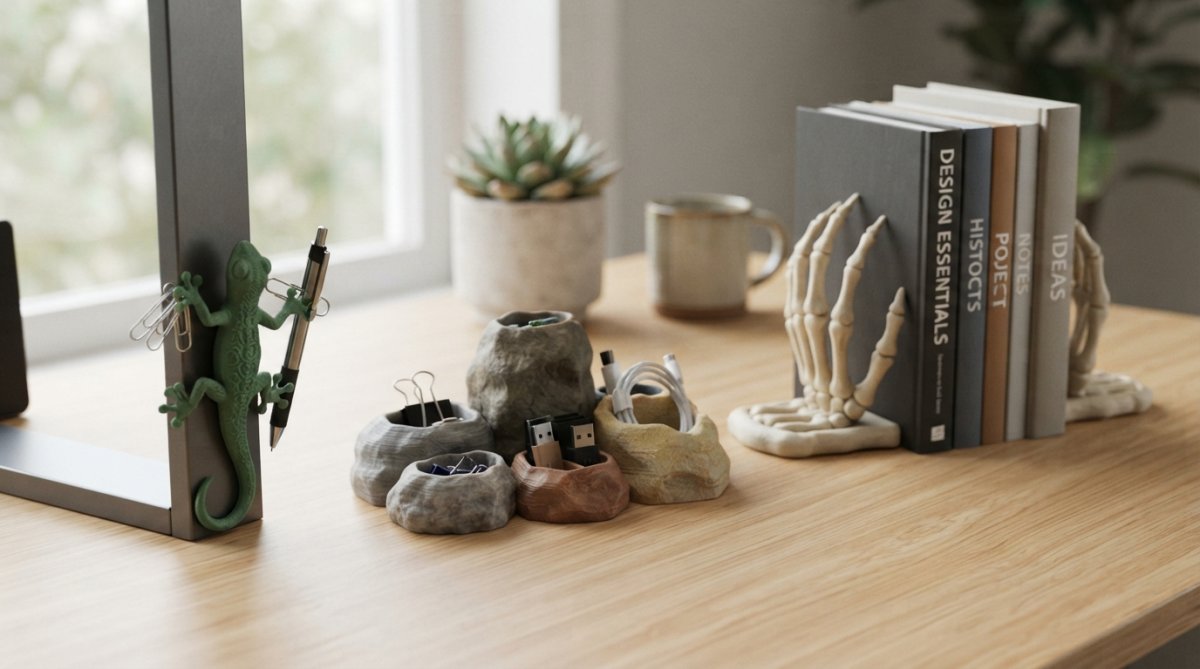
1. Magnetic Gecko Buddy with Storage Rock: The Desk Pet That Holds Your Clips
If you want to keep paperclips and pushpins from rolling across your desk, the Magnetic Gecko Buddy is our top pick for combining cuteness with utility. This 7-inch printed gecko features strong magnetic feet that cling to any metal surface, such as a monitor stand or filing cabinet, keeping vertical space in use. Each gecko comes with a 3D printed "rock" that acts as both a resting perch and a storage spot for small desk essentials.

The design solves desktop clutter by moving small items off your main work surface. Available in color combos like Green & Yellow or Green & Baby Blue, it fits a playful or minimalist desk aesthetic. It also makes a great gift for reptile lovers or anyone wanting a functional desk accessory that sparks conversation.
2. Blob Prehistoric Rocks: Personality-Packed Desk Decor with Hidden Storage
For serious personality in your workspace, the Blob Prehistoric Rocks set offers five goofy geological characters that double as decor. This set includes Lava, Obsidian, Basalt, Amber, and Fossil Blob, each with its own distinct expression and backstory. While primarily decorative, their weight and stable base make them excellent for holding down loose papers.

Crafted to look like they belong in a natural history museum, these rocks appeal to geology lovers and science teachers alike. The 3D printed texture gives each piece a unique feel you don't get with smooth, injection-molded toys. This set brings fun to your daily workflow without sacrificing desk space.
3. Skeleton Hand Bookstop: Functional Gothic Bookend for Your Shelf
The Skeleton Hand Bookstop proves organization can be both functional and wonderfully weird, serving as a sturdy bookend. Inspired by vintage anatomical illustrations, this detailed hand features articulated finger bones that look like they crawled out of an old medical textbook. It is available as a single left or right hand, or as a mirrored pair, for support against a wall or between two book sets.

This isn't just a spooky decoration; it provides real structural support for heavy textbooks or art books. The wide base and dense print ensure it stays put, preventing books from toppling over. For fans of dark academia decor, this bookend bridges the gap between a conversation piece and a practical tool.
Modular 3D Printed Desk Systems: Build Your Own Setup
Beyond individual pieces, the true potential of desk organizers lies in modular 3D printed desk systems that let you build a setup tailored to your workflow. These systems use a grid-based foundation where you can attach components like pen holders, headphone stands, and cable management clips. You can start with a simple base and expand as your needs grow, rather than replacing entire units.
Modularity adapts to your spatial constraints, whether you have a sprawling gaming rig or a compact apartment desk. You can find STL files online to print your own components, or buy pre-printed parts that snap together without extra tools. This flexibility keeps your ergonomic desk layout clean and efficient.
Best Filament for Desk Organizers: What to Look For
Most guides stop at "PLA is fine," but that advice falls apart after a few months of daily use. The real question is which filament survives the specific wear patterns of a desk environment: UV exposure, heat from electronics, friction from sliding items, and point loads from heavy objects. Here is a practical durability breakdown.
PLA (Polylactic Acid): The Baseline, Not the Benchmark
PLA is rigid and prints cleanly, but it has a glass transition temperature of around 60°C (140°F) (PubMed). A desk in a sunbeam can cause warping over time, and PLA is brittle under sustained point loads, a pen holder at 15% infill will crack if you jam oversized markers into it daily. If you stick with PLA, increase wall count to 4-5 and set infill to at least 30% for load-bearing components. For purely decorative pieces like the Blob Prehistoric Rocks, PLA is perfectly adequate.
PETG: The Desk Workhorse
PETG is the sweet spot for functional desk organizers (researchgate.net). It has a higher glass transition temperature (around 80°C / 176°F), making it safe for electronics-adjacent use, and it offers better layer adhesion than PLA, flexing under load rather than shattering. A PETG cable clip will survive being yanked, where a PLA clip would snap. The trade-off is surface finish: PETG is softer and more prone to showing layer lines, so it benefits from post-processing. For a heavy bookend or monitor stand, PETG at 25% infill with 4 walls is reliable.
ABS/ASA: Only for Specific Heat Cases
ABS and its UV-resistant cousin ASA are overkill for most desks unless you have a setup near a heat vent or in an unconditioned space. They require an enclosed printer to avoid warping and emit fumes that demand ventilation. The only desk scenario where ABS is justified is a holder for a soldering iron, where surface temperatures can exceed 100°C (212°F). For 99% of users, the fume and warping headaches are not worth the marginal heat gain over PETG.
A Simple Field Test for Material Claims
If buying pre-printed organizers, you can quickly assess material quality without a spec sheet. Press a thumbnail into a hidden underside edge. If it leaves a dent, the print is likely PLA. Try twisting a thin section, like a clip arm. If it cracks with a sharp snap, it's PLA; if it bends and springs back, it's PETG or nylon. Also check the underside for a smooth, even first layer, a rough bottom indicates poor bed adhesion, compromising the part's structural integrity.
:::tip Material Selection Quick Guide
- PLA: Decorative items, low-stress holders, color-matched aesthetics.
- PETG: Cable management, drawer inserts, bookends, anything with moving parts or point loads.
- ABS/ASA: Only for high-heat environments or soldering stations.
- TPU: For non-scratch pads or flexible cable strain reliefs, though it is rarely needed for desk organizers. :::
Why This Matters for Your Purchase
3D Printing Desk Organization Ideas: Print Your Own Solutions
Printing your own organizers shifts the value equation, not just in cost, but in fit. A store-bought tray is designed for an average desk; a printed one is designed for your desk, your gear, and your workflow. The gap between a functional print and a frustrating one comes down to three factors: weight distribution, surface friction, and print orientation.
Designing for Stability: The Anti-Tip Formula
A common failure with DIY desk organizers is tipping. A tall headphone stand looks great but falls over the first time you bump it. The fix is understanding center of mass. For any organizer over 6 inches tall, the base should be at least 60% of the object's height in depth. Adding a 1-2 mm recessed cavity on the underside lets you insert a steel washer before the final bottom layer prints (using a pause-at-height slicer feature). This adds 50-100 grams of low-profile mass that lowers the center of gravity without changing the exterior design.
Surface Friction: The Sliding Problem
PLA and PETG are both slick on smooth desktops. A printed keyboard wrist rest will slide forward during intense typing. The solution is designing in friction. Print a 0.5 mm raised lip pattern (like a grid of small nubs) on the bottom surface to create micro-interference points that grip the desk. Alternatively, print the bottom 3-4 layers in TPU (flexible filament) using a filament swap. TPU has a high coefficient of friction and will anchor the organizer without scratching the desk.
Print Orientation: Where Strength Actually Comes From
FDM prints are anisotropic, strong along the layer lines but weak perpendicular to them (mdpi.com). A cable clip printed flat will have horizontal layer lines, making it prone to snapping when you pull a cable sideways. The same clip printed on its side will resist that pull significantly better. For any part experiencing tension or shear forces, clips, hooks, drawer slides, orient the print so the force runs parallel to the layer lines. This is the single most impactful factor in part longevity.
Post-Processing for a Non-Plastic Look
The biggest tell of a DIY print is visible layer lines. For organizers in plain sight, a few minutes of post-processing transforms the finish. Start with 120-grit sandpaper, move to 220-grit, and finish with 400-grit. For PETG, wet sanding prevents the material from gumming up the paper. After sanding, a coat of automotive primer filler fills the remaining micro-lines. Once dry, a final sanding with 600-grit and a matte clear coat gives the part a molded appearance. For PLA, avoid acetone vapor smoothing (that works only on ABS) and stick to sanding and priming.
A Practical Starting Point: The Drawer Insert
To test these principles, start with a print-in-place drawer insert for loose tech cables. Measure your drawer's interior dimensions precisely, then design a grid of dividers with 2 mm walls and a 5 mm base. Print it in PETG at 20% infill with 3 walls. The dividers should be 1-2 mm shorter than the drawer height to allow for thermal expansion and easy removal. This project teaches you dimensional accuracy, bed adhesion, and the value of a well-calibrated first layer, all before you commit to a more complex vertical organizer.
:::warning Avoid These Common DIY Pitfalls
- Skipping the brim on tall, narrow prints invites warping and detachment mid-print.
- Using 100% infill wastes filament and time; 30% with 4 walls is stronger than 100% with 2 walls.
- Ignoring elephant's foot (the flared first layer) will make your insert not fit snugly; compensate by chamfering the bottom edge in your CAD model. :::
The Cost Reality Check
A roll of PETG filament costs around $20-25 for 1 kg. A typical desk organizer uses 100-200 grams, putting material cost at $2-5 per item. Even factoring in electricity and failed prints, the per-unit cost is a fraction of retail organizers. The real savings come from iteration: you can print a prototype, test it for a day, and reprint with adjusted dimensions for a few cents in filament. That rapid prototyping loop is something no mass-produced product can offer.
Frequently Asked Questions
What is the best 3D printed desk organizer for small spaces?
For small spaces, look for compact, multi-functional designs. The Magnetic Gecko Buddy with Storage Rock is a great choice because it combines a desk pet with a small storage rock, perfect for holding paperclips or earbuds, and it sticks to any metal surface to save desk space. The Blob Prehistoric Rocks set is also small enough to fit on a shelf without cluttering your work area. Measure your available space and choose organizers that serve more than one purpose.
Are 3D printed desk organizers durable enough for daily use?
Yes, when printed with quality materials like PLA or PETG, they can be very durable. PLA is strong and rigid, ideal for items that won't be exposed to high heat. PETG offers more flexibility and impact resistance, making it suitable for parts that might get bumped. Our products are crafted with attention to detail and durability. Proper print settings, like adequate infill density and layer adhesion, also boost durability.
How do I choose the right 3D printed organizer for my desk setup?
Start by identifying what items create clutter on your desk: pens, cables, notes, or small accessories. Then, match the organizer to your storage needs and aesthetic. If you want a playful touch, the Magnetic Gecko Buddy adds charm while holding small items. For a unique display, the Blob Prehistoric Rocks set works as decor and storage. Also, consider your available surface area and whether you prefer modular systems that can expand with your needs.
Are 3D printed desk organizers cost-effective compared to store-bought options?
Yes, 3D printed organizers can be more cost-effective, especially for custom or unique designs. Store-bought organizers often range from $10 to $50, but our unique 3D-printed items offer distinctive aesthetics you won't find in stores. The durability and personalization often make them a better value than mass-produced items.
Can I customize 3D printed desk organizers to match my gaming setup?
Absolutely. One of the biggest advantages of 3D printing is customization. Many designers offer STL files that you can modify in 3D modeling software to match your color scheme or add personal touches. For pre-printed items, CamGait3D offers multiple color options for the Magnetic Gecko Buddy, allowing you to pick colors that fit your setup.
Keeping your desk organized doesn't mean sacrificing your personality for bland, plastic trays. Whether you need a magnetic companion for your clips or a spooky bookend for your shelf, the right organizer should make your space feel more functional and more yours. At CamGait3D Creations, we focus on crafting unique, durable pieces that add charm to your setup while standing up to daily use. Shop all of our designs to find the perfect printed companion for your workspace.