

Table of Contents
- Why Shoppers Look for a Statu3D Alternative for Unique Figurines
- Custom 3D Printed Figurines for Collectors: What Actually Matters
- Resin vs Filament for 3D Printed Figurines: Which Finish Wins
- How to Order Custom 3D Statues From Photos Without Wasting Money
- A Statu3D Alternative for Unique Figurines: The CamGait3D Creations Catalog
- Pricing, Durability, and Longevity: What Your Figurine Costs Over Time
- Frequently Asked Questions
Last Updated: September 13, 2026
Why Shoppers Look for a Statu3D Alternative for Unique Figurines
The hunt for a statu3d alternative for unique figurines usually starts the same way: you order a custom piece, wait weeks, and open a box that looks nothing like the photos you sent. Collectors often share stories of trying a photo-to-3D service and ending up with a rough, stringy print instead of a display-ready piece.
That frustration is reasonable. Custom 3D printed figurines for collectors live or die on three things: surface finish, fidelity to the source photo, and whether the material holds up on a shelf for years. Get any one of those wrong and the piece reads as a cheap souvenir rather than a memory doll or collectible worth showing off.
This guide breaks down how to evaluate any alternative, what actually separates a good print from a bad one, and how our catalog fits into that picture. Below, we'll show you exactly which specs to check before you spend money, plus the photo problems that sink most custom orders.
Custom 3D Printed Figurines for Collectors: What Actually Matters
For collectors, the deciding factors are scale consistency, surface finish, and print resolution, not marketing language. A figurine that fits an existing display shelf and matches the finish quality of the rest of a collection is worth more than one that claims "high fidelity" without showing proof.
Scale, Surface Finish, and Display Quality
Scale determines whether a piece belongs in your collection or gets shoved in a drawer. A figurine that's too large dominates a shelf; one that's too small disappears next to other collectibles (si.edu). Ask any seller for exact dimensions in inches before ordering, and compare them to the pieces already on your shelf.
Surface finish is the second filter. Layer resolution, measured in microns, controls how visible the print lines are. Lower micron values mean finer layers and a smoother surface. A high-fidelity print at a fine layer height looks nearly seamless after sanding, while a coarse print shows ridges even under paint.
How to Spot Quality Control Before You Buy
Quality control is where most online sellers fall apart, and it's the easiest thing to verify before you commit.
- Ask for photos of a finished piece, not just a 3D rendering
- Request a close-up of the surface to check for layer lines and rough spots
- Confirm whether the item is printed in-house or dropshipped
- Check whether the seller offers a replacement policy for damage in transit
- Look for customer photos, not just studio shots
Resin vs Filament for 3D Printed Figurines: Which Finish Wins
Resin printing can offer detail and smoothness; filament can offer durability and cost. For display collectibles where fine facial features and clean curves matter, resin can be a strong choice. For larger, sturdier pieces meant to be handled, filament can hold up better.
Resin printing uses a liquid photopolymer cured layer by layer with light, which can allow very fine layer resolution and sharp detail. The trade-off can be brittleness and a higher price per piece. Filament printing, also called FDM, extrudes melted plastic, which can be tougher and cheaper but may leave more visible layer lines that need post-processing to smooth out.
For a miniature portrait or a detailed custom action figure, resin can produce a cleaner result. For a desk pet or functional gaming accessory that gets knocked around, filament can be a practical pick.
Layer Height, Nozzle Size, and What the Numbers Mean
Two specs decide how a print looks before any paint touches it: layer height and nozzle diameter. On a filament printer, a standard 0.4 mm nozzle paired with a 0.2 mm layer height can produce visible stepping on curved surfaces. Dropping to a 0.12 mm layer height or a 0.25 mm nozzle can tighten those steps, but may roughly double print time. Resin printers typically run 0.025 mm to 0.05 mm layers, which can result in crisp facial features and thin accessories without sanding.
Ask any seller for both numbers. "High resolution" without a layer height is marketing; "0.05 mm layers on a resin printer" is a spec you can compare across shops.
Post-Processing and Finishing Techniques That Change the Look
Post-processing is a step many buyers may not be familiar with, and it can be the difference between a rough prototype and a finished collectible. Sanding, priming, and hand-painted detail can turn a raw print into something that looks intentional rather than extruded. This is a detail many ordering guides may skip, so it's worth understanding before comparing quotes.
A typical finishing sequence runs in stages:
- Support removal and cleanup. Resin prints come off the build plate with supports that leave nubs; filament prints leave stringing and blobs. Both get clipped and filed before anything else.
- Sanding. Filament pieces start around 220 grit to knock down layer lines, then step to 400, 800, and sometimes 1,500 grit for a glass-smooth surface. Resin usually needs only a light 800-grit pass.
- Priming. A thin coat of primer fills micro-pores and gives paint something to grip. Skip this and paint pools in the layer grooves.
- Painting. Airbrush for broad color and gradients, hand-brush for eyes, faces, and small accessories. Eyes are almost always hand-painted because no printer resolves a clean iris at figurine scale.
- Sealing. A matte or satin clear coat locks the paint and adds a layer of UV and handling protection.
If a seller skips these steps, layer lines may be visible in the final product. It can be helpful to ask directly whether a piece is sanded and sealed, how many grits are used, and whether the paint is airbrushed or hand-brushed. A shop that answers those questions specifically may be the one doing the work.
Raw Prints vs Finished Pieces: What You're Actually Paying For
A raw print and a finished piece can carry the same product name and a 3x price difference. Raw prints ship straight off the machine with visible layer lines, no paint, and no seal. Finished pieces have been sanded, primed, painted, and sealed, which is where most of the labor cost lives.
When you compare a statu3d alternative for unique figurines, check which category each listing falls into. A $7.00 raw print and a $25.00 finished piece aren't competing on the same axis, one is a blank, the other is a display-ready collectible. Knowing which you're buying prevents the most common post-purchase complaint: opening a box expecting a painted figurine and finding an unpainted one.

How to Order Custom 3D Statues From Photos Without Wasting Money
A common cause of a disappointing custom statue can be a bad source photo. Photo-to-3D conversion can only work with what the image shows, so a blurry, low-contrast, or oddly lit photo can produce a soft, imprecise model.
Before you upload anything, start with a clear, well-lit image where the subject is fully visible. Even lighting and a plain background give the software the cleanest edges to trace.
Troubleshooting Common Photo Problems
Most photo issues fall into a handful of fixable categories. Here's how to handle each before you submit an order.
| Problem | Why It Hurts the Print | Fix |
|---|---|---|
| Blurry or low-resolution photo | Loses fine detail in the model | Use a sharp, high-resolution original |
| Harsh shadows | Creates false depth and warped shapes | Reshoot in soft, even light |
| Busy background | Confuses subject detection | Use a plain wall or backdrop |
| Multiple subjects overlapping | Merges figures incorrectly | Photograph each subject separately |
| Low contrast | Weak edges, soft features | Increase lighting contrast |
A Statu3D Alternative for Unique Figurines: The CamGait3D Creations Catalog
Our catalog offers charming, themed characters and sets that add personality to a desk, shelf, or gaming setup. Every piece is 3D printed in-house, ensuring quality control from print to packaging.
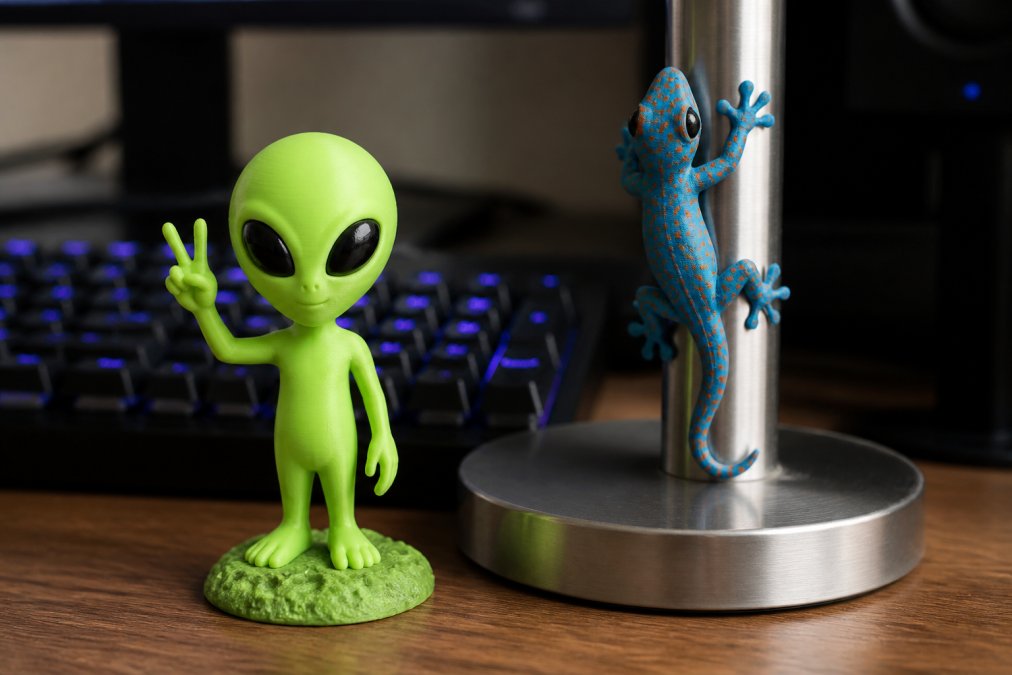
The Tiny Alien figurine and keychain, at $7.00, is our most affordable entry point for anyone testing the waters. It's a freestanding mini alien figure with oversized glossy eyes and a tiny smile, and it doubles as a keychain so you can carry it around. For a desk companion that actually does something, the Magnetic Gecko Buddy at $17.00 clings to fridges, lamps, and filing cabinets thanks to magnetic feet, and it comes with a storage rock.
If you want a set rather than a single piece, the Blob Mushrooms at $25.00 include five mushrooms with a log and stump, while the Blob Prehistoric Rocks set, also $30.00, brings five geology characters to a dinosaur-themed display. Every set ships within 3-5 days and is made from biodegradable PLA, which keeps the pieces lightweight and sturdy.

Pricing, Durability, and Longevity: What Your Figurine Costs Over Time
Durability can depend on material, finish, and placement. A sealed, correctly finished print can hold its color and shape for years on an indoor shelf, while an unfinished print exposed to direct sunlight may fade and degrade faster. The cost of a figurine can be spread across the years it sits on a shelf.
How 3D Printed Figurines Age: UV, Heat, and Handling
PLA, the material we use, is a plant-based polymer that is sturdy for display pieces but can soften in high heat. Two factors to consider over time are:
- UV fading. Pigments in paint and in some filaments break down under direct sunlight. A piece on a south-facing windowsill can visibly shift color within a single summer. A shelf away from direct light keeps colors true for years.
- Heat deformation. PLA begins to soften around 140°F (60°C). That's well below a closed car interior on a summer day, which can exceed 150°F. Keep figurines off dashboards, out of parked cars, and away from heat vents and radiators.
Handling is a factor. Resin pieces can be more brittle and may chip at thin points like fingers or antennae if dropped. Filament pieces may flex slightly before they break, which can make them more forgiving for pieces that get picked up and moved. A clear coat can add a small amount of scratch resistance on top of UV protection, so a sealed piece may last longer than an unsealed one under the same conditions.
Material Safety and Sustainability
PLA is derived from renewable plant starch, typically corn, and is industrially compostable under the right conditions (the EPA). This can make it a lower-impact choice than petroleum-based plastics, though it may not break down in a home compost bin at typical backyard temperatures. Resin is a different story: liquid photopolymer can be a skin and respiratory irritant before it's fully cured, and uncured resin should be handled with care (osha.gov). Fully cured resin prints are stable for display, but the waste stream from supports and failed prints may not be recyclable in most curbside programs.
If material safety and waste matter to you, it can be helpful to ask two questions before ordering: what filament or resin is used, and how the shop handles failed prints and support waste. A shop that prints in-house may be able to answer both; a dropshipper may not.
What Your Figurine Costs Over Time
A quick comparison of our sets against their price and best use:
| Product | Price | Best For |
|---|---|---|
| Tiny Alien Figurine & Keychain | $7.00 | First-time buyers, small gifts |
| Magnetic Gecko Buddy | $17.00 | Desk pets, functional decor |
| Blob Skeletons Set | $25.00 | Halloween and gothic displays |
| Blob Mushrooms Set | $25.00 | Low-maintenance desk greenery |
| Blob Prehistoric Rocks Set | $30.00 | Dinosaur and geology fans |
Every set ships within 3-5 days and is made from biodegradable PLA, which keeps the pieces lightweight and sturdy. Because PLA is a display material, these items are intended as shelf pieces, not as toys for small children.

If a piece arrives damaged or doesn't match the listing, contact the seller directly with photos. A seller who stands behind their work will replace it; one who doesn't will stall.
Frequently Asked Questions
What is the best Statu3D alternative for unique figurines?
The right alternative depends on what you value most: photo-to-3D conversion, hand-painted detail, or a finished collectible you can display the day it arrives. CamGait3D Creations takes the second route, selling ready-made 3D printed sets like the Blob Mushrooms ($25) and Tiny Alien figurine and keychain ($7) instead of a scan-and-sculpt pipeline. That means no photo submission, no modeling wait, and prices you can check before ordering.
Are 3D printed figurines durable enough for display?
Yes, with realistic expectations. CamGait3D Creations prints in PLA, a biodegradable polymer that holds shape well on a shelf or desk. These are decorative collectibles, not toys, so keep them away from toddlers and pets and out of direct sun. Small layer lines and slight texture variations are normal in additive manufacturing and are part of what makes each print unique.
Can I turn a single photo into a 3D printed statue?
A single photo can work, but results improve with more angles. Most photo-to-3D conversion services want at least three to five clear shots: front, both sides, and a three-quarter view. Flat lighting and busy backgrounds cause most failed conversions. If you only have one old photo, expect the sculptor to guess at the back of the head and any hidden details, which shows up in the final print.
How do custom 3D figurine services compare in price and quality?
Photo-based statue commissions typically run well above ready-made printed sets because you pay for 3D modeling time, not just printing. CamGait3D Creations sits at the ready-made end: the Tiny Alien is $7, the Magnetic Gecko Buddy with Storage Rock is $17, and the larger Blob sets range from $20 to $30. Quality differences show up in surface finish, color consistency, and how well small parts hold up.
How long does it take to receive a custom 3D printed figurine?
Turnaround splits into two phases: design and print. Photo-to-3D commissions can take days to weeks for modeling before printing even starts. Ready-made items from CamGait3D Creations are made to order and ship within 3-5 days, based on the processing times listed on each product page. If you need a gift by a specific date, ready-made sets remove the modeling wait entirely.
Finding a statu3d alternative for unique figurines comes down to verifying surface finish, scale, and material before you buy, not trusting a rendering. CamGait3D Creations prints every piece in-house using biodegradable PLA, ships sets within 3-5 days, and builds characters designed to add charm to a desk, shelf, or gaming setup. From the $7.00 Tiny Alien to the $30.00 Blob sets, there's a piece for nearly any collection. Shop all of our designs and find the character that fits your space.